
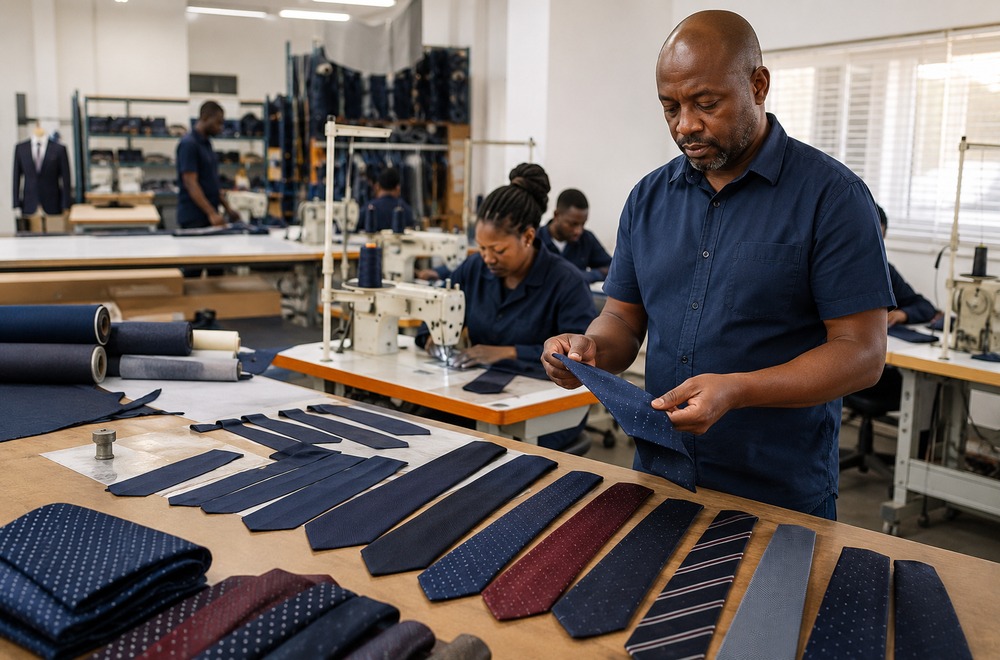
There is something quietly remarkable about longevity in manufacturing. I would say that in any industry, but particularly in textile manufacturing, surviving decades of economic shifts, changing tastes, import competition, and the occasional global disruption takes more than just good products — it takes genuine expertise, built up over years of doing the work properly. South Africa's manufacturing sector has seen many businesses come and go, and the clothing and textile industry has been no exception. Factories that once hummed with activity have closed their doors, and many brands that used to produce locally have quietly outsourced to cheaper overseas suppliers. Against that backdrop, the fact that Vinuchi has remained a committed local manufacturer and supplier of custom ties for longer than most of our competitors have even existed is something worth talking about.
Back in the day, when corporate identity programmes were first becoming a serious business consideration — I am thinking of the 1960s and 1970s, when South African companies began investing heavily in branded uniforms and staff presentation — the demand for quality custom ties grew significantly. Organisations wanted custom ties that reflected their image, their colours, their values. School ties were already a well-established tradition, rooted in the British public school system and carried faithfully into South Africa's own school uniform heritage, but the corporate sector was catching up fast. It was during this period that serious tie manufacturers distinguished themselves from the general clothing trade. Not everyone who sewed fabric was equipped to produce a properly constructed custom ties, and not every printer or weaver understood the specific requirements of woven vs printed techniques, of lining weights, of blade widths, of repeat patterns scaled correctly for a narrow garment. These are details that matter enormously, and they separate tie makers who genuinely understand their craft from those who are simply processing orders.
Vinuchi developed its expertise precisely in this environment, and I would say that accumulated knowledge is genuinely difficult to replicate. When a new client comes to us with a brief for custom ties — whether that is a school updating its uniform range, a financial institution launching a rebrand, or a hospitality group outfitting its front-of-house team — we are drawing on decades of practical experience. We know what works and what doesn't. We know that a particular shade of navy will reproduce differently in a woven jacquard than it will in a printed microfibre. We know which construction methods hold their shape over repeated wear and which ones will look tired after a season. That kind of knowledge is earned, not purchased.
Don't get me wrong — there are other suppliers of custom ties in the South African market, and some of them do decent work. But there is a meaningful difference between a supplier who sources finished ties from an overseas factory and badges them locally, and a manufacturer who is genuinely involved in the production process. These days, with global supply chains and digital printing making entry into this market relatively easy, the distinction between a tie manufacturer and a tie reseller has become somewhat blurred. I think clients deserve to understand that difference when they are making purchasing decisions, particularly for something as identity-critical as a school tie or a corporate tie that will represent their brand every single day.
The materials and processes involved in producing quality custom ties are more involved than most people realise. Woven ties, in particular, require significant lead time and technical precision. The pattern must be engineered for the loom, colours must be matched to yarn dye lots, and the weave structure itself affects how the finished tie drapes and knots. Printed ties offer more flexibility for complex photographic designs or short runs, but the quality of the substrate fabric and the printing process make an enormous difference to the final result. These are conversations we have with clients regularly, and they are conversations that require genuine manufacturing knowledge rather than a catalogue and a price list.
One could say that the necktie industry has always rewarded patience and precision above all else. It is a small, specialised world, and the clients who invest in properly made custom ties — rather than the cheapest available option — tend to understand intuitively that they are investing in their own image. Looking ahead, I believe the demand for quality bespoke neckwear will remain strong in South Africa, driven by institutions and organisations that take their identity seriously. And for those clients, knowing that they are working with the longest established manufacturer in the country is, I would think, not a small thing at all.