
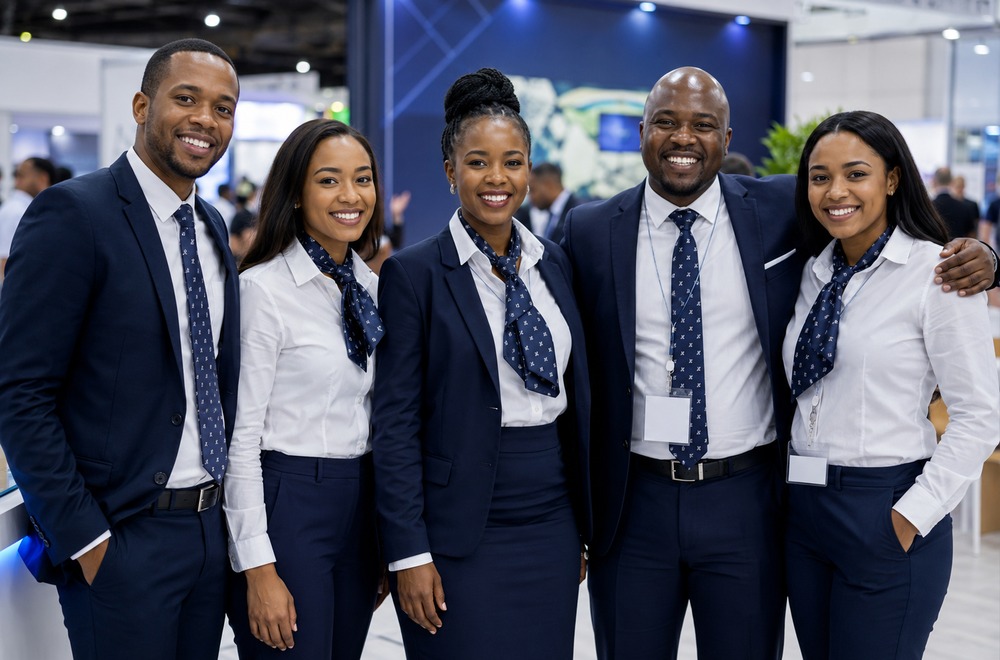
There is a moment, I would say somewhere in the early decades of the twentieth century, when corporate identity stopped being purely about what a company *did* and started being about what a company *looked like*. The shift was gradual, almost imperceptible, but it was real. Organisations began to understand that the people representing them on the street, in the boardroom, and behind the counter were, in a very tangible sense, walking advertisements. Uniforms became more deliberate. Colours were chosen with intention. And neckwear — that curious accessory with its roots in Croatian military dress and the fashionable courts of Louis XIII — found itself repurposed as one of the most powerful tools in the corporate identity toolkit. It is within this context that I think we need to talk honestly about custom ties and corporate scarves, and specifically about the relationship between them, because these days far too many organisations treat them as entirely separate decisions when, in reality, they are anything but.
Let me explain what I mean. When a company commissions custom ties, they are making a statement about formality, about hierarchy in some cases, and almost always about brand consistency. The tie has carried that weight for well over a century — think of the British public school traditions that fed directly into the South African school uniform heritage we know so well, where a striped or crested tie told you immediately which institution a young person represented. Corporate culture borrowed heavily from that tradition. Back in the day, a company tie was a mark of belonging, of pride even. What has changed in the modern context is not the underlying purpose but the scope of the conversation. Custom ties are no longer the only item on the table, and this is where corporate scarves enter the picture in a way that I think deserves far more attention than it typically receives.
Corporate scarves are, for many organisations, the natural complement to a custom tie programme — and at Vinuchi, we have seen this play out consistently across industries. A financial institution might commission custom ties for its male client-facing staff and assume the conversation ends there. But what about the women in those same roles? What about the brand experience they are delivering? Corporate scarves, designed with the same colour palette, the same logo treatment, the same sense of intentional identity, solve this problem elegantly. I would say they solve it better than most organisations realise, because a well-designed scarf carries significantly more visual real estate than a tie. The palette can breathe. The pattern can tell a richer story. Done properly, corporate scarves do not merely echo the custom ties in a programme — they elevate the entire uniform.
Don't get me wrong, this is not simply an aesthetic argument. There is a practical manufacturing logic to it as well. When custom ties and corporate scarves are developed together — from the same design brief, using complementary yarn palettes or print references — the result is a cohesive identity that holds up under real-world conditions. When they are commissioned separately, often from different suppliers working in isolation, you end up with what I can only describe as brand drift. The navy on the tie and the navy on the scarf are almost the same. Almost. And in a well-lit reception area or on a conference stage, almost is not good enough.
At Vinuchi, our approach has always been to treat these two products as part of a single conversation. Whether we are producing woven custom ties for a financial services group or printed corporate scarves for a hospitality brand, the question we ask is always the same: what is this organisation trying to communicate, and how do these pieces work together to communicate it? That question, I would say, is the most important one any tie manufacturer can ask — and it is the one that separates manufacturers who genuinely understand corporate identity from those who are simply filling orders.
One could say that the future of corporate ties lies precisely in this kind of integrated thinking. As organisations become more deliberate about diversity, inclusion, and the full representation of their teams, the demand for custom ties and corporate scarves designed as a unified suite will only grow. The companies that understand this early, and work with tie manufacturers who think beyond the single product, will be the ones whose brand identity feels genuinely considered rather than assembled in pieces.