
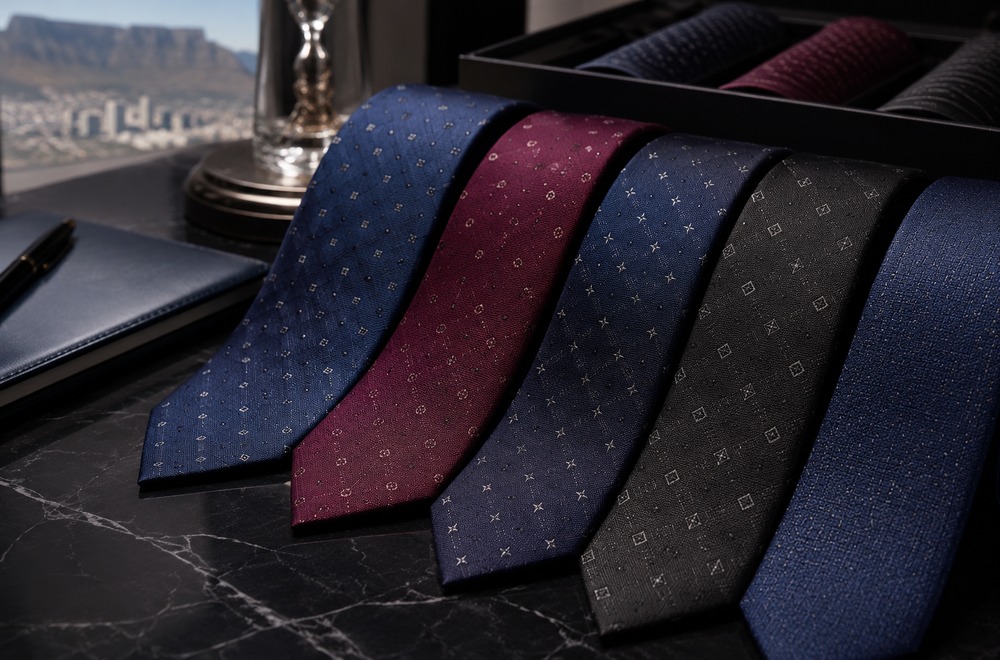
There is something fascinating about the way corporate identity evolved in South Africa during the latter half of the twentieth century. Back in the day, a company's visual identity was largely confined to a letterhead, a logo on a reception wall, and perhaps a uniform shirt. The idea that accessories — something as seemingly incidental as custom ties — could carry the full weight of a brand was not yet part of the conversation. But over the decades, as organisations grew more sophisticated in how they presented themselves to the world, the custom ties and corporate scarves began to find each other in the most natural of partnerships. These days, I would say that the relationship between custom ties and corporate scarves is one of the most underutilised branding opportunities available to South African businesses, and that is a gap worth talking about.
Custom ties have long been the cornerstone of corporate dress standards. From the banking sector to aviation, from hospitality groups to insurance firms, custom ties have served as a quiet but powerful signal of belonging and professional identity. When a client walks into a branch and every staff member is wearing the same woven tie in the company's exact Pantone colours, something registers — a sense of order, of intention, of pride in appearance. At Vinuchi, we have been manufacturing custom ties for corporate clients for many years, and I can tell you that the briefs we receive are increasingly thoughtful. Clients are no longer just asking for custom ties that matches their logo. They want a garment that tells a story, that carries texture and craftsmanship, that says something meaningful about who they are as an organisation.
Now, here is where corporate scarves enter the picture, and don't get me wrong, corporate scarves are not simply a feminine alternative to custom ties. That thinking is outdated and, I would say, a little lazy. Corporate scarves serve a genuinely different function. They bring warmth, versatility, and a different visual language to the uniform equation. A well-designed scarf can be worn in multiple ways — as a neck scarf, a shoulder drape, or even tied to a handbag — and this flexibility gives it a reach that custom ties simply does not. When an organisation invests in both custom ties and corporate scarves, designed from the same colour palette and pattern logic, what they are really doing is creating a complete visual ecosystem. The effect on the floor, whether that floor is an airport terminal, a hotel lobby, or a corporate reception area, is remarkable.
The challenge, of course, lies in getting the two garments to speak the same visual language without becoming monotonous. This is where the expertise of a quality manufacturer becomes genuinely important. At Vinuchi, we approach these dual briefs with a great deal of care. The custom ties might carry a bold repeat of the company's geometric logo motif in a woven jacquard construction, while the corporate scarves interpret the same motif at a larger scale, perhaps as a border print or a central placement, with a softer hand feel appropriate to the fabric. One could say that the custom ties and scarves become two chapters of the same story — distinct enough to be interesting, unified enough to be unmistakably part of the same brand family.
There is also a practical conversation to be had about the manufacturing process itself. Printed ties and woven ties behave very differently as branding vehicles, and the same is true of corporate scarves produced through digital print versus screen print versus woven methods. These are the kinds of decisions that tie manufacturers — real tie makers with production knowledge, not simply resellers — need to guide clients through honestly, because the wrong choice for the wrong budget in the wrong fabric can undermine the entire investment.
I genuinely believe that as South African businesses continue to mature in their approach to brand expression, the coordinated use of custom ties and corporate scarves will become far more standard than it currently is. The companies that understand this pairing today are, in my experience, the ones that tend to take their people and their presentation seriously. And that, at the end of the day, is exactly the kind of client we love working with at Vinuchi.