
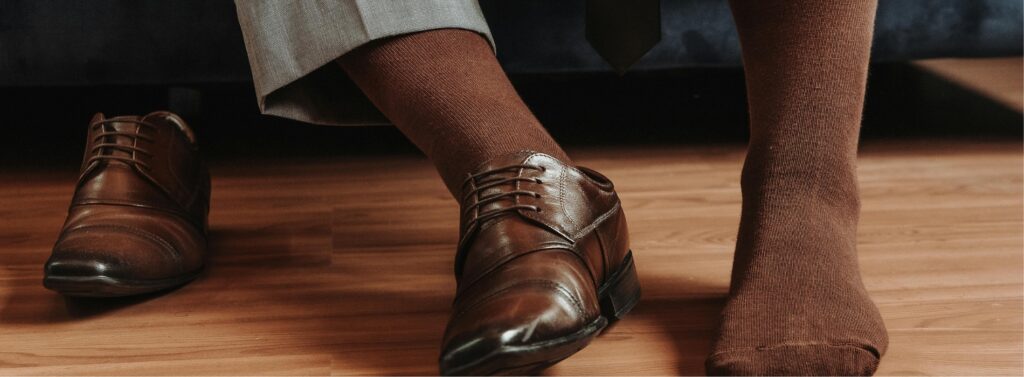
There is something quietly fascinating about the way corporate branding evolves. Back in the day, when companies first started investing seriously in their visual identity — I am thinking of that golden era of the 1960s through to the 1980s — the conversation was almost entirely about logos, letterheads, and uniforms. Custom ties were a big part of that story, of course. The corporate tie became a kind of shorthand for institutional belonging, a woven or printed signal that said *I represent this organisation, and I take that seriously.* At Vinuchi, we have watched that evolution up close for a long time, and I would say that corporate ties remain one of the most elegant branding tools ever developed. But something interesting has been happening on the periphery of that conversation, something most people in the industry did not see coming. Custom socks have quietly, almost unexpectedly, become one of the most talked-about items in corporate gifting and brand identity circles — and honestly, I find that fascinating.
Don't get me wrong, I am not suggesting that custom socks are about to replace custom ties as a corporate staple. That would be a stretch. But what I am saying is that the underlying logic is surprisingly similar. When a company invests in quality corporate ties — properly as woven ties or printed ties with the correct Pantone colours, precise logo placement, and a construction that holds its shape — they are communicating something about their standards. Custom socks, these days, are being used in exactly the same way. Branded with company colours, logos, or even clever design motifs, they show up in onboarding packs, year-end gifts, and conference goodie bags. And because they are unexpected, they land differently. People actually wear them. People talk about them. There is a tactile delight to well-made custom socks that creates a kind of brand memory that a generic pen simply cannot.
From a manufacturing perspective, the parallels between producing quality ties and producing quality custom socks are worth exploring. In both cases, the difference between something that looks cheap and something that looks considered comes down to a few key decisions: the yarn or fabric weight, the construction method, the colour accuracy, and the finishing. Printed ties always look a little more buoyant compared to woven ties — and the same principle applies here. Custom socks that have been properly knitted with the design built into the structure of the fabric will always outperform one where the branding has simply been screen-printed on afterwards. These are the kinds of details that manufacturers who genuinely care about quality think about, and they are the details that the end recipient, even if they cannot articulate why, will absolutely notice.
I think about the trajectory of school ties as a useful reference point. Matric ties, for instance, carry enormous emotional weight precisely because they are made with intention — specific colours, specific crests, specific year references. Matric ties are not just a piece of fabric; they are a marker of achievement and belonging. Corporate custom socks, at their best, are tapping into something similar. They are small, wearable declarations of identity. And when they are made well, they carry that message long after the initial gift has been given. The parallel with matric ties might sound like a stretch, but I genuinely believe the psychology is the same. People attach meaning to objects that feel considered and crafted.
What I find particularly interesting, from where we sit as tie manufacturers and makers of custom socks, clothing and knitwear at Vinuchi, is that the rise of custom socks has not cannibalised the tie market so much as it has expanded the conversation about wearable branding altogether. Companies that might never have considered a corporate tie programme are now thinking about branded accessories more broadly — and that often leads them back to the tie as the anchor piece. Custom socks become the conversation starter; the tie becomes the foundation. One could say they are complementary rather than competitive, and I think that is exactly right.
The broader shift here is that corporate identity has become more layered and more human. Branding is no longer just about what hangs in the reception area or appears on the letterhead. It lives in the small, personal, everyday details — and custom socks, unexpected and delightful as they are, have found a very comfortable home in that space. I would say the companies that realise this earliest will be the ones with the most coherent and memorable brand presence going forward. And for those of us who have spent years crafting quality woven products, that is a future worth being genuinely enthusiastic about.