
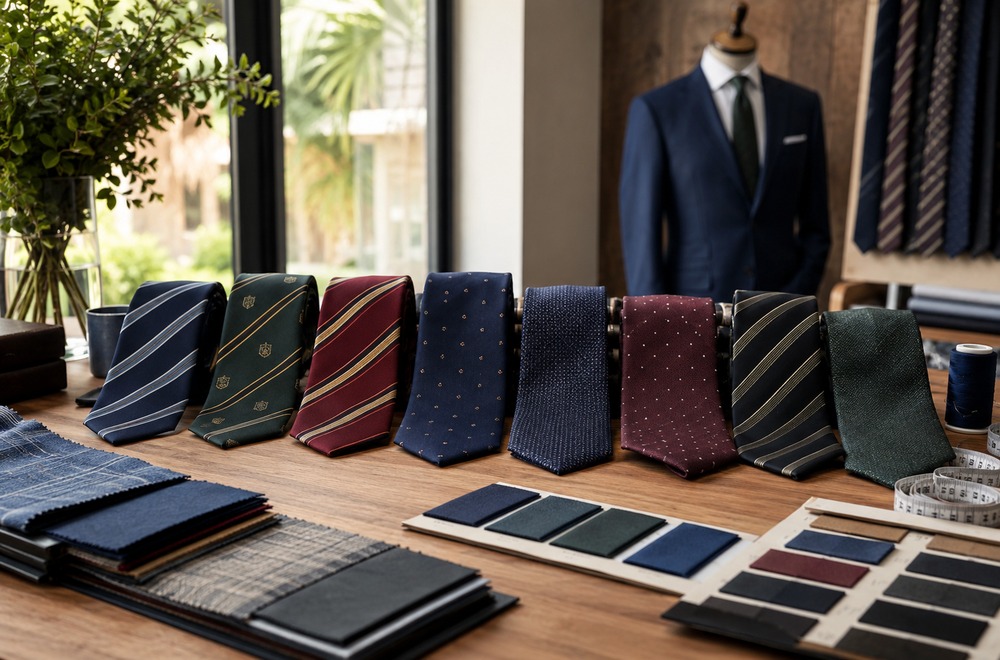
There is something quietly fascinating about the way certain traditions evolve over time, not by abandoning their roots, but by folding new meaning into old forms. Custom ties are a perfect example of this. When Croatian mercenaries arrived in France during the Thirty Years' War and Louis XIII took such a shine to their distinctive cravats that he made them fashionable at court, nobody was thinking about school uniforms or corporate identity. They were thinking about military bearing and aristocratic elegance. And yet, that single moment of cultural borrowing set in motion a chain of influence that would eventually produce two of the most enduring forms of the necktie as we know it today — school ties and custom ties — and, I would say, bring them closer together than most people realise.

Back in the day, the school ties were very much their own world. British public schools adopted neckwear as part of their uniform traditions during the nineteenth century, using distinctive colours and stripe patterns to create a visible sense of belonging and institutional pride. The tie became a kind of wearable badge — immediately readable to anyone who knew the codes. South African schools inherited this tradition wholesale, and it took root here with remarkable tenacity. Walk through any South African town today and you will still find schools where school ties are treated as a serious matter of identity, where the colours and the weave carry genuine meaning for learners, staff, and alumni alike. School ties here have never really been a formality. They have always been a statement.

What is interesting, though, is how the logic behind school ties — the idea that a tie could communicate belonging, values, and identity at a glance — migrated into the corporate world and gave rise to what we now call custom ties. During the 1960s through to the 1980s, as South African companies began developing stronger corporate identities, the branded tie emerged as a natural extension of that thinking. Organisations started commissioning ties in their house colours, incorporating logos and motifs into the design, creating something that functioned almost exactly as school ties did, but for a boardroom rather than a classroom. One could say the corporate world simply looked at what schools had been doing for a century and decided it was rather a good idea.

These days, the relationship between custom ties and school ties has become so intertwined that at Vinuchi, we often find ourselves drawing on the same design thinking for both. A school commissioning new ties for its centenary, and a financial services firm wanting ties that reflect their rebranding — the conversations are more similar than you might expect. Both are ultimately about making something that carries genuine meaning, something that people will wear with a sense of pride rather than mere obligation. That, I would say, is the real standard worth chasing. Custom ties that feel like an afterthought, that could belong to anyone, miss the entire point of what a custom tie is supposed to do.

Don't get me wrong, there are differences worth acknowledging. School ties tend to work within a more conservative design language — stripes, crests, specific institutional colours — because continuity matters enormously in an educational context. A school's tie might run largely unchanged for decades, and that consistency is part of its value. Custom ties for corporate clients often have more room to evolve, to incorporate contemporary design sensibilities, to be refreshed as brand identities shift. But even here, the best custom ties tend to borrow something from the school tie tradition: a clarity of purpose, a commitment to quality materials, and an understanding that the people wearing custom ties are, in some small way, representing something larger than themselves.

What the history of neckwear teaches us, I think, is that the most enduring forms are always the ones that carry meaning beyond mere fashion. School ties have survived every wave of casualisation in dress codes because they are not really about fashion at all. And the finest custom ties — the ones that clients return to commission again and again — succeed for exactly the same reason. At Vinuchi, that connection between purpose and craft is something we take seriously, whether we are working on school ties for a new institution or custom ties for an established brand that wants something genuinely distinctive. The tradition is centuries old. The conversation, it turns out, is still very much alive.