
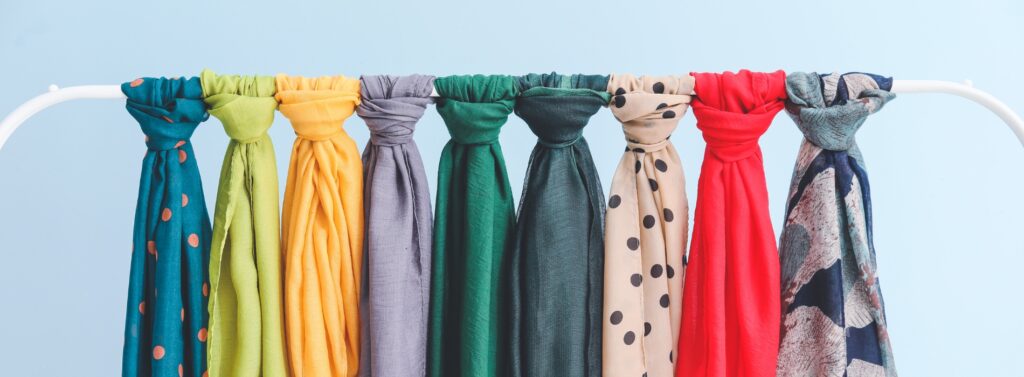
There is something that has always puzzled me about the way organisations approach their uniform and corporate identity programmes, and I think it is worth talking about openly. When a company finally decides to invest in custom ties — and it is always a meaningful investment when done properly — the conversation almost always stops there. The custom ties get ordered, the colours get matched, the woven or printed decision gets made, and then everyone packs up and goes home. The corporate scarves, which could complete the entire picture, get left behind as an afterthought, or worse, never get considered at all.
I would say this happens because ties have such a long and dominant history in corporate identity that they naturally take up all the oxygen in the room. Think about it — the whole tradition of custom ties as a symbol of professional belonging stretches back centuries, from the Croatian soldiers whose knotted neckwear caught the attention of Parisian fashionistas in the 1600s, right through to King Louis XIII formalising the cravat as a mark of distinction, and eventually into the British public school tradition of the striped tie as a badge of house and institution. South Africa inherited so much of that tradition through its own school uniform heritage, and it carried directly into corporate culture as the country's modern business identity developed through the 1960s, 70s, and 80s. Custom ties became the currency of belonging. So I understand why they dominate the conversation. Back in the day, that made complete sense.

But here is what I think organisations are missing in 2024. The modern workplace, particularly in South Africa where so many companies have mixed-gender workforces and genuinely want their identity pieces to speak to everyone equally, needs more than a tie programme. Corporate scarves serve the same fundamental purpose as custom ties — they communicate belonging, they reinforce brand colours, they project professionalism and unity — but they do it in a way that works for a far broader cross-section of your team. One could say the scarf is the tie's more inclusive sibling, and I genuinely believe that.

Don't get me wrong, I am not suggesting that ties are going anywhere. At Vinuchi we have been manufacturing custom ties for South African corporates, schools, and organisations for many years, and the demand remains strong. Woven ties in particular, where the design is built into the very structure of the fabric rather than printed onto the surface, carry a quality and longevity that serious organisations recognise and value. When a client comes to us for custom ties, we always talk about the difference between woven and printed, about thread counts and fabric weights, about how the tie will hold its shape and colour over years of use. These are conversations I love having because they speak to craftsmanship, and craftsmanship is at the heart of what we do.

But these days, the best brief I can receive from a corporate client is one that includes corporate scarves in the same conversation. When you approach the design of your neckwear identity holistically — thinking about how corporate ties and corporate scarves will work together as a coordinated family of items — you get a far more powerful result. The colours sing together. The branding is consistent. The organisation looks cohesive whether you are looking at the gentleman in the boardroom or the receptionist at the front desk. That coherence is enormously valuable, and it costs far less than most people realise when you plan it properly from the start rather than coming back six months later to add the scarves as an expensive afterthought.

I would also make the point that quality corporate scarves, like quality custom ties, are not a category where you want to cut corners. The weight of the fabric, the finish of the edges, the vibrancy and colorfastness of the weave or print — all of these things matter enormously in how the item looks after repeated wear and washing. At Vinuchi, we apply exactly the same rigour to our scarf manufacturing as we do to our corporate ties, because poorly made corporate scarves reflect on the brand wearing it just as badly as a poorly made tie does.
The future of corporate identity in South Africa, I genuinely believe, belongs to organisations that think in complete sets. Corporate ties and corporate scarves, planned together, made to the same quality standard, expressing the same brand story. That is what a proper uniform programme looks like, and it is a conversation I am always happy to start.