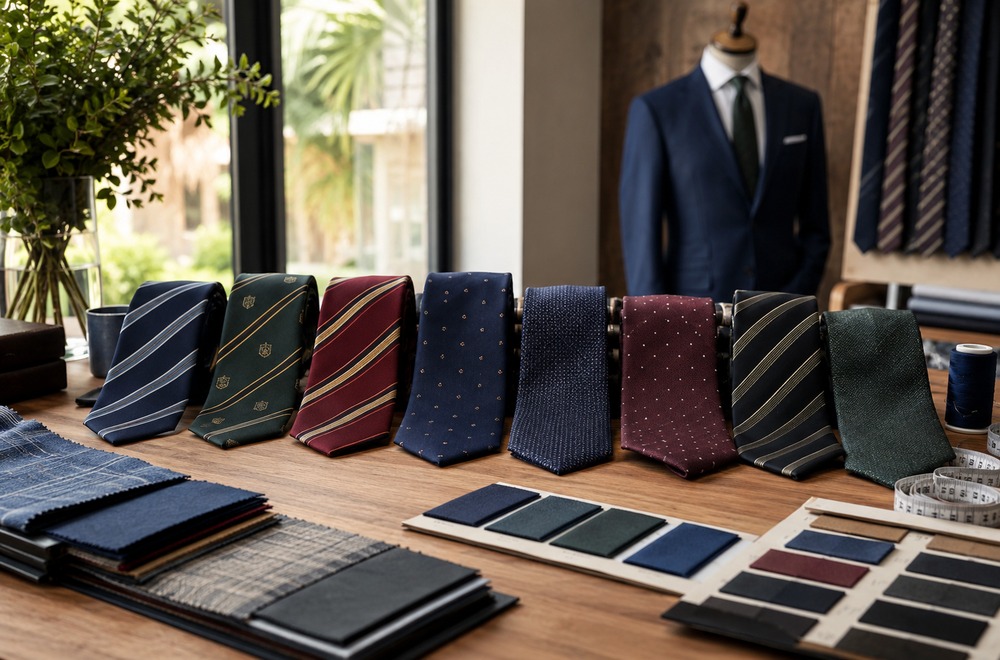
There is a question I get asked fairly regularly in this industry, usually by someone who is ordering for the first time or putting together a brief for their company's uniform rollout: are corporate ties the same thing as custom ties, or are they something different entirely? It is one of those questions that sounds simple on the surface but actually opens up a rather interesting conversation about how the custom ties industry works, how terminology evolved, and why the distinction matters more than most people realise.

Let me start with a bit of context that I think helps frame this properly. If you trace the evolution of custom ties from its military origins — and I mean the era when European armies were adopting the cravat as a functional part of dress uniform, where regiments were literally identified by the colour and style of cloth worn at the neck — you begin to understand something fundamental about what a tie has always represented. It was never just decoration. It was identification. It was belonging. A soldier's neckwear told you, at a glance, which regiment he served, which side he fought on, which institution claimed him. That idea never really went away. It simply changed its uniform.

British public schools picked this up beautifully. The house tie, the school tie, the prefect's tie — these became one of the most enduring examples of woven identity in clothing history. South African schools followed suit, and if you grew up here, you know exactly what I mean. The tie on your blazer told the whole story: which school, sometimes which grade, sometimes which achievement. These were not off-the-shelf items. They were designed, specified, and produced to represent something particular. They were, by every reasonable definition, custom ties.

Corporate ties are, I would say, the natural heir to that same tradition. When organisations began developing stronger visual identities through the 1960s, 70s, and 80s — that golden era of corporate branding when companies started taking their livery seriously — the tie became one of the most visible and consistent elements of staff presentation. Banks, airlines, hotel groups, large retailers: all of them eventually arrived at the same conclusion. Custom ties worn by their people needed to say something specific about their brand. It needed to reflect their colours, their character, sometimes their logo. And that meant working with tie manufacturers who could produce something tailored to those requirements. Corporate ties, in other words, were always custom ties by nature.

This is the point I try to make when clients come to us at Vinuchi, sometimes expecting these to be two separate categories of product. Don't get me wrong, I understand why the confusion exists. In everyday conversation, people use "corporate ties" to describe a certain style and application — the formal, branded neckwear you see on a bank teller or an airline crew member — and they use "custom ties" to describe the process of creating something unique to a specification. But the reality is that corporate ties sit squarely under the umbrella of custom ties. They are not a deviation from the custom process; they are one of its most common and important expressions.

What does that process actually involve? These days, when a company approaches us about corporate ties, there is a proper design consultation, fabric and construction decisions to be made, choices between printed and woven ties, and decisions about repeat pattern size, colour matching to brand standards, and minimum quantities. Woven ties, which I personally regard as the superior product in most corporate applications, require a jacquard loom setup that incorporates the design directly into the fabric structure. Printed ties offer more flexibility at certain quantity levels but behave differently in terms of texture and longevity. Both fall under the custom ties category. Both require a manufacturer who knows what they are doing.

The South African market has its own particular character in this space. We are a country with a strong school and corporate uniform culture, and that means there is a genuine, ongoing demand for quality corporate ties produced locally. Back in the day, a lot of this work went offshore, but there is real value in working with local tie manufacturers who understand the market, can manage lead times responsibly, and are genuinely invested in the outcome.

I would say the clearest way to understand the relationship is this: all corporate ties are custom ties, but not all custom ties are corporate ties. It is a subset, not a separate world. And recognising that helps businesses ask better questions, plan more effectively, and ultimately end up with a product that does exactly what a tie has always been meant to do — tell people, at a glance, exactly who you are.