There's a moment, I would say, that most people in the corporate world have experienced — standing in front of a mirror, straightening a tie that perfectly matches the company's brand colours, and not once wondering how custom ties actually came to exist. Who made it? Where was the fabric sourced? How many decisions went into that finished product hanging neatly around their collar? It's one of those things we take entirely for granted, and yet the story behind all well-made custom ties is far more layered than most people realise.

When you trace the necktie back through its evolution from military dress to business attire, you begin to appreciate just how much intention has always gone into what we wear around our necks. Long before the tie became a symbol of corporate identity, it was a marker of regiment, rank, and belonging — soldiers in formation, each distinguished by the colours and patterns of their unit. That tradition of using neckwear to signal membership and identity never really left us. It simply migrated from the battlefield into the boardroom, and from the parade ground into the school courtyard. These days, when a company commissions custom ties for their staff, or a school orders a new run of school ties with freshly updated crests, they're participating in a tradition that is centuries old — even if nobody's thinking about that while placing the order.

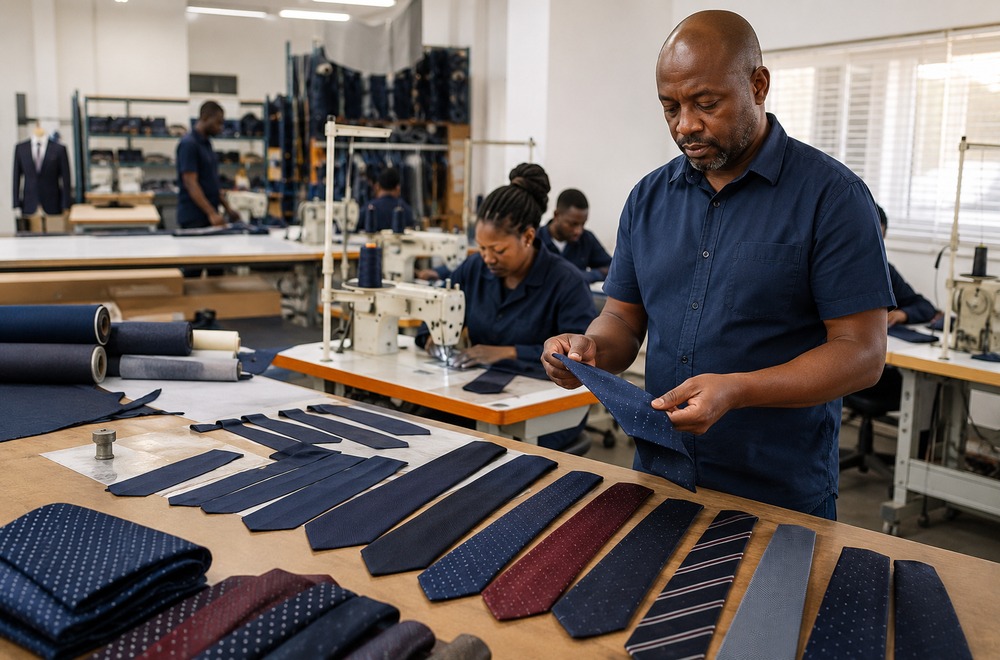
And this is exactly where tie manufacturers become absolutely essential. Don't get me wrong, I understand that many clients simply see the process as transactional — you want a tie, you place an order, you receive a product. But the reality of what happens in between is where quality is either built or lost entirely. At Vinuchi, we live in that in-between space. Every custom tie we produce involves a series of deliberate choices — fabric weight, construction method, interlining selection, the number of panels in the cut, the way the pattern is engineered to fold correctly when the custom ties are knotted. None of this happens by accident, and none of it is trivial.

One could say that the single biggest distinction in this industry is the difference between printed and woven ties, both custom ties and I think this is a conversation that not enough clients are having with their suppliers before placing orders. Printed ties are produced by taking a base fabric and applying the design on top of it, which generally allows for faster turnaround and greater detail in complex artwork. Woven ties, on the other hand, have the pattern built directly into the fabric itself during production, resulting in a product with considerably more depth, texture, and longevity. Both have their place, and experienced tie manufacturers will guide you through that decision based on your volumes, your budget, and ultimately what you want the tie to say about your brand or institution.

Back in the day, the Southern African textile manufacturing landscape was considerably more robust than what we see today. There were more looms running locally, more finishing houses, more vertical integration within the supply chain. The contraction of that industry over the decades has meant that tie makers who are still operating at a quality level have had to become far more resourceful — building relationships with international fabric suppliers, investing in specialist equipment, and maintaining the kind of craft knowledge that simply cannot be outsourced or automated away. At Vinuchi, we've navigated that reality carefully, and I would say it has made us better tie manufacturers, not in spite of those challenges but because of them.

What strikes me about the custom ties category specifically is how much it continues to grow in relevance, even as broader workplace dress codes have relaxed. Schools remain a cornerstone — South African school uniform heritage runs deep, and a well-made school tie carries real institutional pride. Corporates continue to use branded custom ties for everything from staff uniforms to client gifts to event merchandise. Sports federations, golf clubs, professional associations — the demand is consistent, and the expectation of quality is, if anything, rising.

The future of this industry, I believe, belongs to tie manufacturers who treat every order — whether it's fifty ties or five thousand — with the same level of craft and accountability. The tie itself may be a small thing. But what it represents, and the expertise required to produce it well, is anything but.