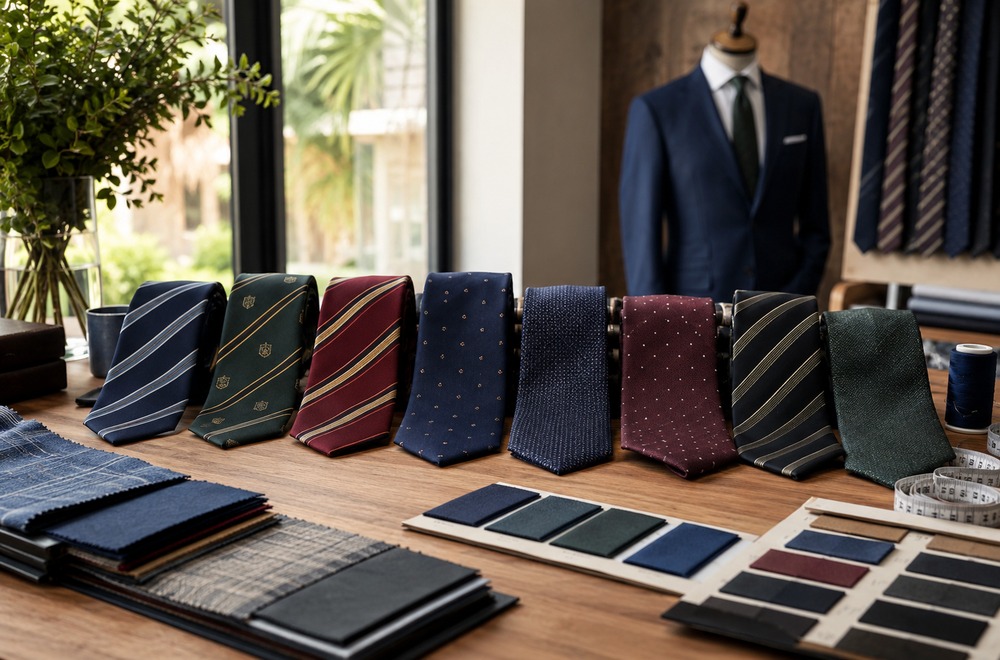
There is a conversation I find myself having rather frequently with procurement managers, HR professionals, and marketing executives across South Africa, and it goes something like this: someone phones us at Vinuchi asking for "branded ties" and what they actually want — once we have talked it through — turns out to be something quite different from what that phrase typically means in our industry. I would say this confusion is one of the most common misunderstandings in the corporate clothing space, and it is worth unpacking properly, because the distinction genuinely matters when you are investing in your organisation's visual identity.

Let me start with what branded ties actually are in the strictest sense. These days, the term gets used loosely to describe almost any tie that carries a company's colours or logo, but back in the day, tie manufacturers had a much cleaner definition. Branded ties are essentially custom ties that had been badged — meaning a woven or printed label, a small embroidered motif, or a subtle repeated pattern incorporating a logo had been applied to an otherwise standard product. Think of the house ties you see in department stores with a small crest near the blade tip. That is a branded tie in the traditional sense. The branding is incidental to the tie itself; it is applied rather than intrinsic. Corporate tie programmes in the 1970s and 1980s worked largely on this model, where a manufacturer's existing range would be adapted minimally to carry a client's identity. It was practical, it was affordable, and for many organisations it was entirely sufficient.

Custom ties, however, are a different conversation altogether. When we produce custom ties at Vinuchi, we are talking about a product that has been designed from the ground up to reflect a specific brief — the precise Pantone references of a corporate palette, a proprietary pattern, a particular weight and hand-feel of fabric, a specific construction method, all of it considered deliberately. One could say that a custom ties are a piece of designed intellectual property expressed in silk or print or weave whereas a branded ties are more of a personalised product. Don't get me wrong, there is absolutely a market for both, and neither is inherently inferior. But conflating the two leads to disappointment, particularly when a client expects the tailored precision of the latter and receives the adapted simplicity of the former.

Where it gets genuinely interesting — and this is the part I enjoy explaining — is that branded ties and custom ties are not mutually exclusive categories. In fact, the best corporate tie programmes I have seen in South Africa are ones where the two concepts overlap almost entirely. A truly well-executed branded tie programme results in a tie so specific to the organisation that it functions as a custom tie in every practical sense. The branding is not stuck on top; it is woven into the identity of the garment itself. At Vinuchi, this is the standard we hold ourselves to when we work with clients on their corporate identity pieces — the branded tie should feel like it could not have been made for anyone else. That is the benchmark.

The distinction also matters from a production standpoint. Custom ties, for instance, can carry very detailed artwork and are typically more accessible from a minimum order and cost perspective, making them a popular route for branded ties that need to be turned around quickly or produced in smaller volumes. Woven custom ties, on the other hand, require pattern cards, loom setup, and longer lead times, but they produce a depth of colour and a textural richness that printed ties simply cannot replicate — and for organisations where custom ties are a genuine symbol of institutional pride, whether a corporate house or a school, that quality difference is visible and meaningful.

I would say the South African market has matured considerably in how it approaches this. Tie manufacturers here have had to develop real sophistication to serve clients who are increasingly design-literate and expectant of international quality standards. The conversation has shifted from "can you put our logo on a tie" to "can you help us build a tie that represents who we are." That shift — from badging to designing, from branded ties to custom ties — is, in my view, the most exciting development in this industry in the past two decades, and it shows no signs of reversing.