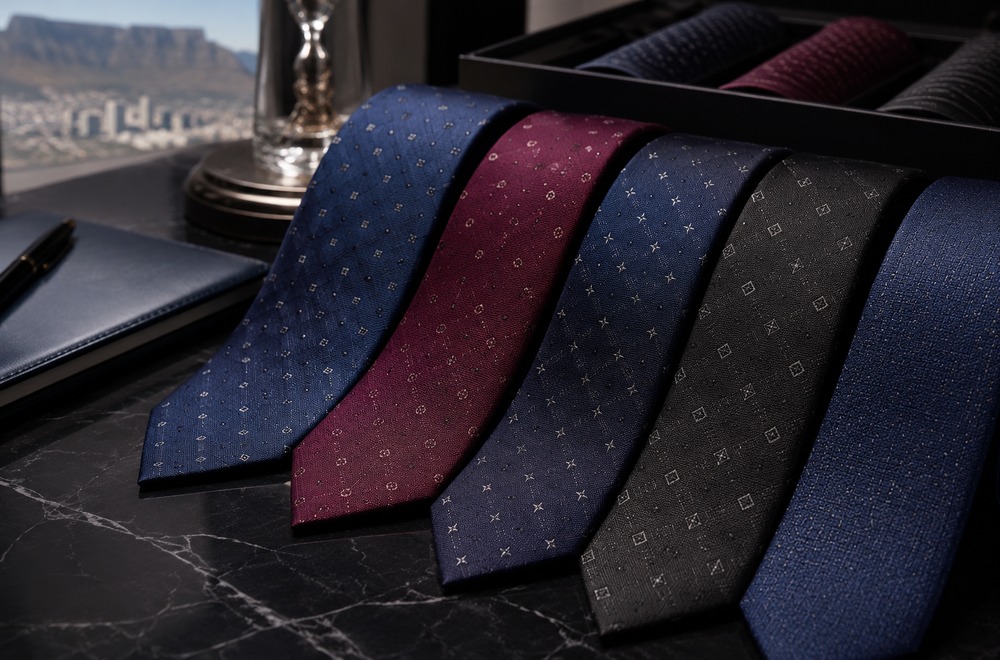
There is something quietly remarkable about the way a well-made tie commands attention in a room. I would say it's one of those things that people feel before they consciously notice it — a sense of quality, of intention, of a brand or institution that takes itself seriously. And when you start asking where that kind of neckwear actually comes from in this country, the name Vinuchi tends to come up rather quickly. That's not a coincidence. It's the result of decades of consistent craft, genuine attention to detail, and a deep understanding of what clients in South Africa actually need from a tie manufacturer.

Back in the day, quality neckwear manufacturing in Southern Africa was a fragmented affair. Most organisations with serious uniform requirements — schools, corporates, sports clubs — were either importing from the UK or Europe, or settling for locally produced ties that left something to be desired in terms of finish and consistency. The British public school tradition had influenced our own school uniform culture deeply, and there was a strong expectation around what  school ties or corporate ties should look and feel like. Meeting that expectation locally, at scale, and with any real degree of artistry, was genuinely difficult. That's the environment in which companies like Vinuchi had to prove themselves, and I think that context matters when you understand why the reputation they've built carries the weight it does.

There is a distinction worth making here that I don't think gets enough attention in conversations about the industry, and that's the difference between tie manufacturers and what I'd loosely call tie makers. Tie maker assemble a product. Tie manufacturers understand the full process — the selection of raw materials, the behaviour of different fabrics under tension, the way colour shifts between a printed design on screen and the final woven or printed result on silk or polyester. Vinuchi sits firmly in the manufacturer category, and that shows in the finished product. Don't get me wrong, there are decent suppliers operating in this market, but the level of technical knowledge required to consistently produce custom ties that accurately reflect a client's brand colours, logo geometry, and pattern repeat is not something every operation gets right.

These days, the demand for custom ties has actually grown in interesting ways. You might expect that in a more casual working culture, where open collars and smart-casual dress codes have become standard in many industries, the corporate tie would be in decline. And yes, certain sectors have loosened up considerably. But what I've observed is that the organisations still investing in ties — schools, banks, law firms, hospitality groups, sports federations — are investing more carefully. They want a tie that functions as a genuine brand asset, not just an accessory. That shift towards intentionality has played directly into Vinuchi's strengths, because producing a custom tie that carries real brand authority requires exactly the kind of expertise and process discipline they've developed over the years.

One could say that the history of custom ties is a history of identity and allegiance. When Croatian soldiers introduced the precursor to the modern cravat to the French court in the 17th century, and when King Louis XIII made it a fashionable statement, neckwear was always about signalling something — rank, affiliation, refinement. School ties in South Africa have carried that same weight for generations. The tie your child wears to a good school tells a story about tradition and belonging. The custom ties your executive team wear at a client presentation tells a story about your company's values. Getting that story right in fabric and colour is a more precise undertaking than most people appreciate from the outside.

What Vinuchi has managed to do — and I think this is genuinely worth acknowledging — is to hold a high standard through the kind of market changes that have pushed many manufacturers towards shortcuts. The temptation to move entirely towards cheaper printed ties at the expense of woven quality is real and understandable from a margin perspective. But printed and woven ties serve different purposes and carry different signals, and a manufacturer that understands both processes can actually serve clients far better. Vinuchi operates with that understanding, which is part of why their custom ties continue to be specified by some of the most recognised institutions in the country.

The future of neckwear manufacturing in South Africa, I would say, belongs to those who treat the product with the seriousness it deserves. Craft doesn't go out of fashion — it just becomes rarer, and therefore more valued.