
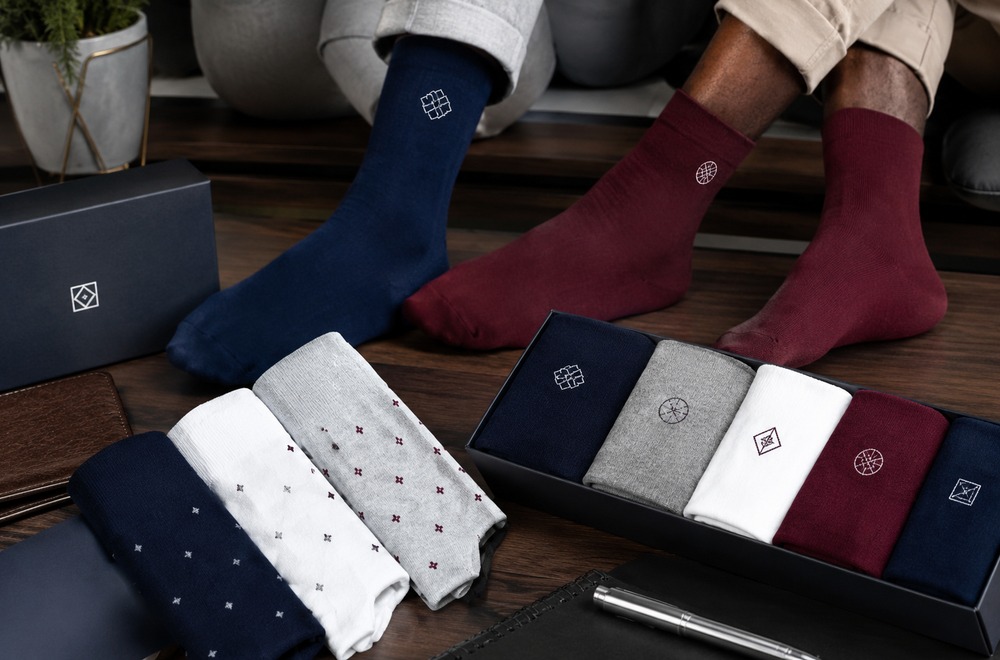
There is a moment that happens in every boardroom, every school assembly hall, and every corporate event where someone walks in and you notice them — not because of anything dramatic, but because everything is just *right*. The shoes are polished, the custom ties are crisp, and yes, even the socks make a statement. I have been in the textile and uniform manufacturing space long enough to know that this kind of cohesion does not happen by accident. It is the result of someone, somewhere, making deliberate decisions about how a brand or institution presents itself from the collar down to the ankle. These days, more and more organisations are waking up to the fact that corporate socks deserve exactly the same attention as custom ties, and I would say this shift has been a long time coming.

It is worth understanding where the tradition of coordinated professional dress actually began, because the roots go deeper than most people realise. When military dress codes evolved through the 18th and 19th centuries into civilian and eventually business attire, uniformity was the point. Every element of dress communicated rank, belonging, and discipline. The British public school tradition took this further — it was school ties, the house colours, the matching school socks and blazer that told the world which institution you attended and what values that institution stood for. South Africa inherited much of this tradition, and anyone who attended a traditional South African school will remember that the uniform code was absolute. The socks had to be the right colour, pulled to the right height, and they mattered just as much as the tie around your collar. One could say that South African schools taught an entire generation of professionals that accessories are never an afterthought.

That sensibility carried into the corporate world, particularly from the 1960s through the 1980s, when South African companies began investing seriously in corporate identity. Uniform programmes became a genuine business tool, and the tie was central to that story. But here is what I find fascinating — and where I think the industry sometimes got it wrong — corporate socks were often left to chance. A company would invest in beautifully branded custom ties, carefully chosen colours, woven with precision, and then send their staff out wearing whatever socks happened to be in the drawer that morning. Don't get me wrong, custom ties were always going to be the hero of the corporate uniform, and rightly so. But the missed opportunity was real.

At Vinuchi, we have spent years working with schools, corporates, and organisations who understand the full picture. When a client comes to us for custom ties, the conversation very naturally extends to the complete uniform. And increasingly, that conversation includes corporate socks. What we find is that clients who have already made the investment in quality branded neckwear are exactly the people who appreciate why coordinated corporate socks complete the look. They understand branding. They understand that consistency builds trust, and that every touchpoint — from the receptionist's tie to the technician's socks — communicates something about the organisation's standards.

The manufacturing side of this is interesting too. Back in the day, corporate socks and custom ties came from entirely different supply chains, different factories, often different countries. These days, the appetite for consolidated, locally produced corporate accessories is growing, and I would say South Africa is well positioned to meet that demand. Custom ties and quality corporate socks both require attention to material, colour accuracy, and durability — and those are skills that serious manufacturers on this continent have been quietly building for decades.

I would also argue that the rise of corporate socks as a deliberate branding tool is part of a broader and very healthy trend toward authenticity in professional dress. People are moving away from the idea that only the most visible items matter. A sales team that arrives at a client meeting wearing matching corporate socks and sharp custom ties is not being frivolous — they are demonstrating that their organisation cares about the details. And in business, caring about the details is usually a very good indicator of how a company will treat its clients.

The future of corporate accessories, I believe, belongs to organisations that think holistically. Custom ties remain the cornerstone of branded professional dress, and that is unlikely to change. But the organisations that will truly stand out are the ones that understand corporate socks are not a footnote — they are part of the same sentence.